Spiritual awakening signs and stages follow a recognizable pattern, even though the experience feels intensely personal. Most people encounter a handful of unmistakable signals, move through distinct phases, and emerge with a fundamentally different relationship to themselves and to life. Understanding what those signs are, and where you are in the process, turns a confusing experience into a navigable one.

What Is a Spiritual Awakening
A spiritual awakening is a shift in consciousness. You begin to perceive yourself as more than your thoughts, your job, or your social role. The psychologist Carl Jung called this individuation. Spiritual traditions across cultures describe it as moving from a contracted, ego-centered awareness to a wider, more interconnected sense of self.
It is not a single moment. It is a process, and for most people it takes months or years. Some describe it as feeling “switched on” after years of sleepwalking. Others say the world stopped making sense in the old way, and a new way of understanding began to emerge.
The Most Common Signs You Are Awakening
These signs appear across accounts from people of every background and belief system. You do not need to experience all of them, but recurring clusters of these experiences are a strong signal.
- A growing sense that something is deeply wrong with your current life, even when nothing specific has changed
- Heightened sensitivity to the emotions of others, to noise, to crowds, or to violence in media
- Recurring synchronicities, the feeling that meaningful coincidences are happening too often to be random
- Questions that will not quiet down: Who am I, really? Why am I here? What happens after death?
- A pulling away from relationships or habits that once felt normal but now feel hollow or draining
- Vivid dreams or a shift in sleep patterns, often accompanied by unusual clarity or symbolic imagery
- Physical sensations such as tingling in the head or spine, pressure at the crown, or waves of warmth through the body
- A sudden loss of interest in things you once pursued with energy, sometimes called the “dark night of the soul”
- Moments of profound stillness or unity, brief periods where separation between self and surroundings dissolves
Not every sign is pleasant. Many people describe the early phase as isolating, frightening, or physically exhausting. That reaction is normal. The nervous system and the sense of identity are both reorganizing.
The Seven Stages of Spiritual Awakening
Researchers and teachers in this field generally map the journey through several distinct phases. The stages are not perfectly sequential. You can move between them, revisit earlier ones, or experience two at once.
Stage 1: The Trigger
Every awakening begins with a disruption. It might be a loss, an illness, a near-death experience, a meditation practice that cracked something open, or a moment of silence that lasted long enough for a deeper question to surface. The trigger breaks the automatic momentum of ordinary life and creates a gap.
Stage 2: Disorientation and the Dark Night
After the trigger comes confusion. Your old map no longer fits the territory. Relationships that were central may feel suffocating. Career achievements may feel pointless. Spiritually, this is sometimes called the dark night of the soul, a term from the 16th-century mystic St. John of the Cross. It feels like loss because it is loss: the loss of a smaller self.
This stage is the most frequently misread. People assume they are depressed or broken, when in fact they are shedding an identity that no longer fits. The distinction matters because the appropriate response is different. Depression needs treatment. A dark night needs witnessing, patience, and in many cases, guidance.
Stage 3: Seeking
Out of disorientation comes hunger. You begin reading, meditating, attending spiritual groups, consulting teachers or readers, or sitting with silence more deliberately. The seeking phase is characterized by openness. You are less defended and more genuinely curious. Many people find that psychic or intuitive guidance becomes meaningful here, as an outside perspective can reflect back what internal experience cannot yet articulate.
Stage 4: Glimpsing
At some point you have a direct experience of something beyond ordinary consciousness. It might last seconds or hours. A meditation sits differently. A conversation carries unexpected weight. A moment in nature dissolves the boundaries of self. These glimpses are not the destination; they are evidence that the destination exists. They also raise the stakes. Once you have tasted that quality of awareness, the ordinary mind becomes harder to settle for.
Stage 5: Integration
Integration is the long middle phase that most people underestimate. You have had glimpses. You are doing the practices. But the insights need to migrate from peak experiences into everyday responses. How do you respond when someone criticizes you? How do you show up when you are tired and irritated? Integration is where awakening either deepens or stalls.
This is the stage where practical tools matter most: journaling, somatic practices, honest relationships, and sometimes continued work with a guide or reader who can help you see what you have normalized or avoided.
Stage 6: Deepening
After extended integration, something settles. The seeking becomes less frantic. The identity questions lose their urgency, not because they are answered but because the question of “who am I” is no longer frightening. You can hold it with curiosity. Presence becomes less effortful. Responses to difficulty are slower and more spacious. This does not mean you are unaffected by life. It means the effect passes through you differently.
Stage 7: Embodiment
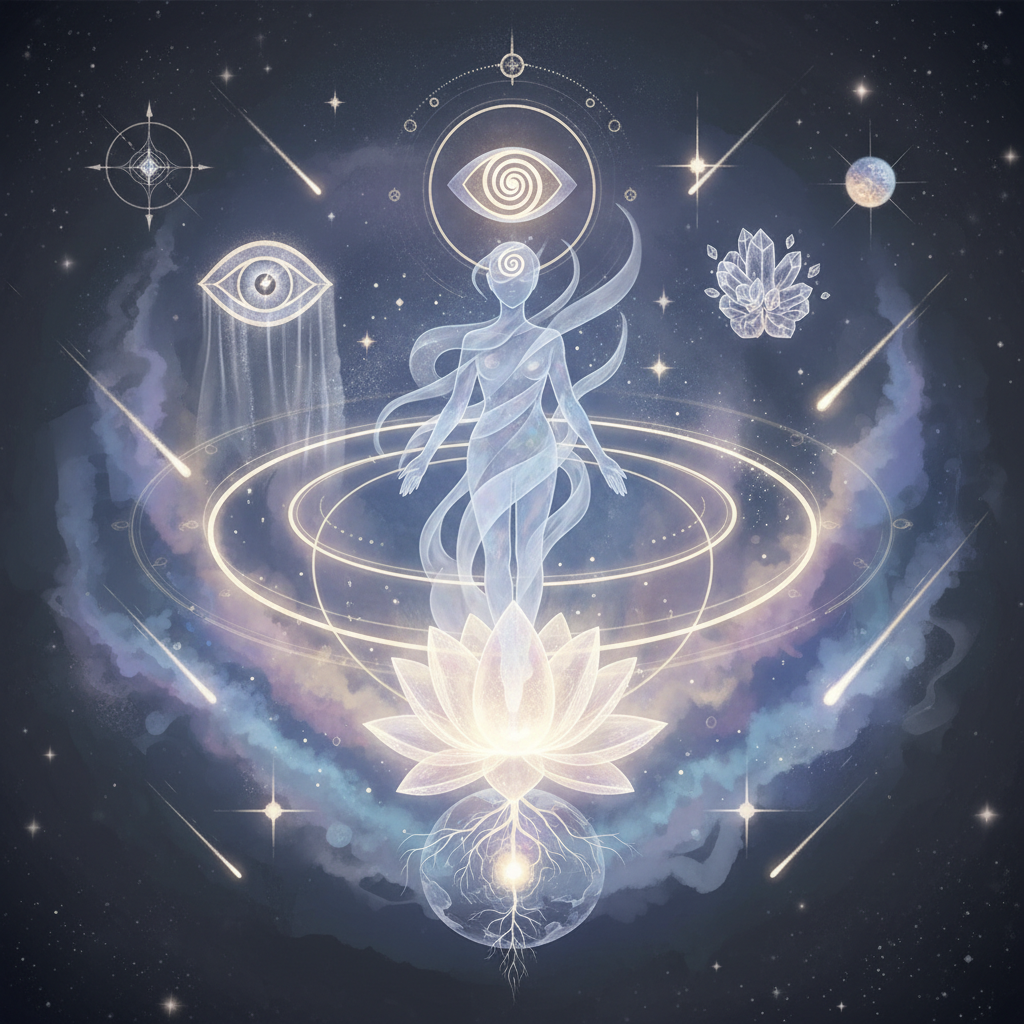
The final stage, which very few people fully reach and most circle around, is embodiment. Awareness is not something you access during meditation and lose in the parking lot. It becomes the background of all experience. Teachers from Advaita Vedanta, Zen, and Christian mysticism all describe something similar: not a state but a ground. Life continues with its textures of joy and difficulty, but the one experiencing it is no longer identified with the surface movements.
Practical Steps for Anyone Currently Awakening
If you recognize yourself in the stages above, these steps help the process move with less resistance.
Keep a daily log. Write down synchronicities, unusual dreams, and emotional shifts. Patterns surface over weeks that are invisible day to day.
Reduce sensory overload deliberately. Awakening heightens perception. Protecting quiet time is not avoidance; it is maintenance.
Find one person who can hear you without fixing you. That might be a therapist, a spiritual director, a trusted friend, or an experienced psychic reader who can witness your experience without either dismissing it or amplifying it into drama.
Slow down major decisions. The seeking phase often generates an urge to leave jobs, relationships, or cities immediately. Some of that is genuine guidance. Some is the ego’s attempt to outrun discomfort. Give the impulse a season before acting on it.
Choose practices over peak experiences. Meditation, breathwork, time in nature, and honest conversation build the capacity to hold expanded states. Chasing peak experiences without that foundation tends to destabilize rather than deepen.
If you are navigating this process and feel uncertain about what specific experiences mean for your path, a live psychic reader can offer a grounded perspective. A good reader does not tell you what to do. They reflect what your own intuition is already moving toward, and they can help you distinguish between spiritual opening and ordinary anxiety, two things that can feel identical from the inside.
How to Know Which Stage You Are In
The stage model is a map, not a judgment. A few questions can orient you:
Do you feel a persistent sense of wrongness without a clear cause? You are probably in Stage 2.
Are you consuming a lot of spiritual content and feeling energized by it? Stage 3.
Have you had clear glimpses of expanded awareness but cannot seem to stabilize them? Stage 4 moving into Stage 5.
Are you mostly stable but notice that reactive patterns still run beneath a calm surface? Deep in Stage 5.
Do ordinary moments sometimes carry a quality of completeness without needing anything added? Stage 6.
No stage is better than another as a moral judgment. They describe development, not worth.
Common Misconceptions About Spiritual Awakening
The most damaging misconception is that awakening resolves ordinary human difficulties. It does not. Awakened people still experience grief, anger, and failure. The difference is in how those experiences are held, not in whether they occur.
A second misconception is that awakening is inherently solitary. Some of the most effective navigation of this process happens in relationship, whether with teachers, communities, or skilled readers who can see around the corners of your own blind spots.
Third, many people believe awakening requires a specific religious framework. It does not. The markers described in this article appear in accounts from secular people, scientists, and contemplatives from every tradition, and from people with no tradition at all.
Closing Thoughts
Spiritual awakening signs and stages point toward a process that is real, measurable in its effects, and navigable. The confusion you may be feeling has a context. Others have moved through it before you. The disorientation that characterizes the early phases is not evidence of failure; it is evidence of genuine change.
The destination is not a permanent high or an escape from ordinary life. It is a deepened capacity to be present with what is actually here, and a loosening of the suffering that comes from resisting it. That is worth moving toward, carefully and honestly.
Frequently Asked Questions
What are the first signs of spiritual awakening?
The earliest signs typically include a persistent sense that something in your life no longer fits, heightened sensitivity to the emotions of others, and questions about identity and purpose that feel urgent rather than abstract. Many people also notice an increase in meaningful coincidences and vivid or unusual dreams. These signs often arrive before any deliberate spiritual practice begins.
How long does a spiritual awakening last?
There is no fixed timeline. For some people the most intense phase lasts months; for others the process unfolds over several years. The early disorientation tends to be the most acute, while integration is a quieter, longer process. The shift in awareness does not have a clear endpoint because it deepens rather than finishes.
What is the dark night of the soul in spiritual awakening?
The dark night of the soul refers to a period of profound disorientation and inner emptiness that often follows an awakening trigger. It was named by the 16th-century Spanish mystic St. John of the Cross. During this phase, old sources of meaning fall away before new ones are established. It is painful but it is not depression, though the two can co-exist. The dark night is a sign that a smaller identity is dissolving to make room for something larger.
What physical sensations accompany spiritual awakening signs and stages?
Common physical sensations include tingling or pressure at the crown of the head, warmth moving through the spine, a feeling of electricity in the extremities, and shifts in sleep patterns. Some people experience fatigue during intense phases as the body adjusts. These sensations are associated with what many traditions describe as the movement of energy through the body’s subtle channels and are widely reported across cultures.
Can a psychic reading help during a spiritual awakening?
Yes. A skilled psychic reader can offer grounded perspective on what you are experiencing, especially during the seeking and integration stages when internal clarity is limited. A good reading does not impose a direction; it reflects patterns your own awareness is already circling. It can help you distinguish between genuine intuitive pulls and fear-based impulses, which can look similar when you are in the middle of a significant shift.